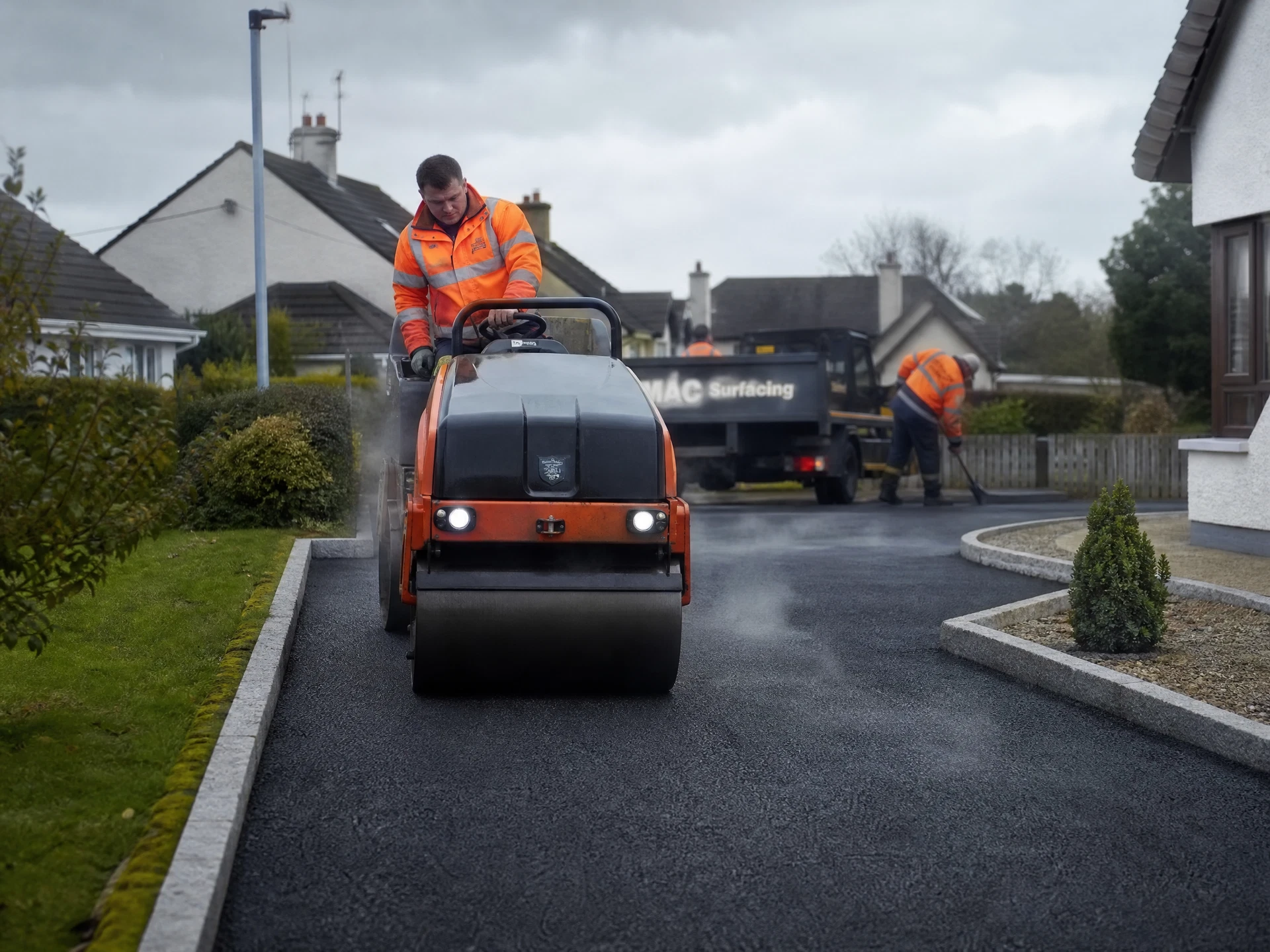
We lay tar and chip driveways across Bray, Greystones, Enniskerry and the wider Wicklow and south Dublin area. The process is straightforward: a hot bitumen emulsion is sprayed or poured onto the prepared base, then natural aggregate — typically 10mm or 14mm stone in a range of colours — is rolled into the surface while the binder is still tacky. The result is a bound, textured surface that grips well underfoot and under tyre.
Why tar and chip suits Wicklow driveways
Tar and chip has been used on Irish roads and private driveways for decades, and it earns its place in Wicklow specifically because the natural stone aggregate blends well with the granite landscape. A charcoal or grey-brown chip against a black binder sits comfortably beside Wicklow granite walls and rendered farmhouses alike, without the formality of block paving or the plasticky sheen of a cheap resin job.
The textured surface provides better grip than plain tarmac in wet conditions — relevant in north Wicklow, where autumn leaves and coastal moisture make smooth surfaces treacherous. It is also more forgiving of minor ground movement than rigid surfaces: the bitumen layer flexes rather than cracks, and the aggregate gives the surface a degree of permeability that reduces ponding.
For rural properties, long private lanes and working farmyards, tar and chip is often the most practical choice: it handles heavy vehicles better than resin, it does not require the precision of block paving, and it can be refreshed with a new surface dressing in ten to fifteen years at a fraction of full replacement cost.
Aggregate choices and finishes
The stone you choose determines the final appearance. The most popular options in the Bray and Wicklow area are natural grey limestone, golden flint, brown quartzite and black basalt — all available in 10mm and 14mm sizes. Larger aggregate gives a coarser, more rural texture; smaller chip produces a tighter, more refined finish that suits suburban frontages.
Blended aggregates — two colours mixed — are increasingly popular because they give a more natural, varied appearance than a single stone. A charcoal-and-buff blend, for example, echoes the colour variation of Wicklow granite without the cost of natural stone paving.
Coloured chip is also available for those who want a warmer or more distinctive look. Red and terracotta chips are used on some rural properties; white limestone chip is popular on longer lanes where visibility matters at night.
Base preparation and installation
The base matters as much for tar and chip as it does for any other surface. A tar and chip layer applied over a failed or inadequate base will crack, rut and shed stone within a couple of seasons. We excavate to formation, lay a geotextile separation membrane, and build up a minimum 150mm of compacted Clause 804 hardcore before any bitumen is applied.
Where an existing tarmac or concrete base is sound and at the right level, we can apply tar and chip as a surface dressing directly — this is the most cost-effective option and is common on driveways that are structurally fine but visually tired. Where the base has failed, we excavate and rebuild rather than paper over the problem.
The bitumen emulsion is applied at the correct temperature and rate for the ambient conditions — Irish summer temperatures and Atlantic humidity both affect open time, which is why experienced crews matter. The aggregate is spread immediately and rolled in two passes with a smooth roller, then any loose stone is swept back and the surface is left to cure for 24–48 hours before traffic.
Tar and chip prices in Bray
Tar and chip is the most affordable solid-surface driveway option available. The guide figures below reflect full-specification work including base preparation — not a surface dressing applied over whatever is already there.
| Item | Guide price |
|---|---|
| Surface dressing over sound existing base | €25–€35 per m² |
| Full tar and chip (excl. new base) | €30–€45 per m² |
| Full tar and chip (incl. new 150mm base) | €55–€75 per m² |
| Granite kerb edging | €40–€60 per linear metre |
| Typical 2-car driveway (50 m²) | €2,500–€4,000 |
Guide prices include VAT at 13.5%. Every job is measured and confirmed with a written quote.